

Articulate Localization for Rise and Storyline
Making AI-based e-learning localization release-ready
Articulate Localization can speed up translations directly in the authoring tool. In practice, however, it is not the “one-click” that matters, but the process: terminology, review, technical limitations, media mix, and updates.
Our focus: We make multilingual e-learning courses release-ready. With AI where it makes sense. With human review and technical QA where it would otherwise be expensive or risky.
What is Articulate Localization in Articulate 360?
Articulate Localization is a built-in feature of Articulate 360 that enables AI-based translation of Rise and Storyline courses directly within the authoring tool. It accelerates multilingual production but does not replace professional review, terminology management, or technical quality assurance.
In short: How we can help
- Setup and governance for Articulate Localization (roles, review, terminology, tone)
- QA workflows from language 3 onwards, when internal teams can no longer reliably assess quality
- Secure media mix: UI strings, subtitles, optional audio, interactive assets
- Update-proof processes to ensure corrections are not “lost in translation”
- Export and publication (including SCORM checks)
20-minute setup check:
Together, we look at tools, media mix, languages, and update frequency, and show where QA effort arises and how it can be managed in a stable manner.
Contact/appointment: Appointment page
Who is this relevant for?
Articulate Localization is particularly well suited when…
- multiple language versions need to be maintained in parallel
- regular updates are required and consistency must be maintained
- not only text, but also UI, subtitles, and optionally audio are included in the course
- Emphasis is placed on terminology and brand tone
Caution is advised when…
- much of the content is contained in images, screenshots, PDFs, or videos
- there are complex interactions (e.g., storyline, trigger logic) in the game
- the expectation is “translated = done”
One-click vs. reality: What is really covered?
Typically well covered:
- Text blocks, headings, course structure text
- Quick drafts for initial reviews
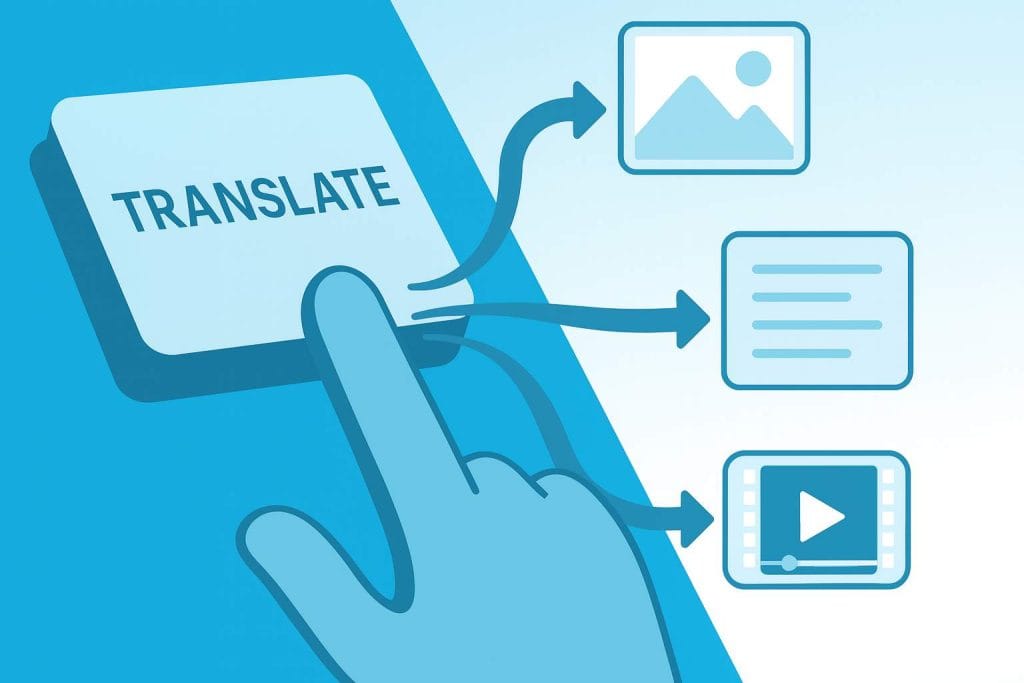
Typically not done automatically (and therefore process issues):
- Images with text, screenshots, infographics
- Embedded PDFs or external documents
- Videos with on-screen text
- Storyline blocks and many interactive special cases
- Layout sequences (text lengths, breaks, timing, buttons)
Why this is important: This is precisely where rework, technical QA, and costs arise that are missing from many calculations.
- Text in the editor (paragraphs, titles)
- Navigation & UI texts of the tool
- Subtitles
- Text in images
- Layout & design (DTP)
- On-screen text in videos
Our approach as a technical solution
1. Preparation before the first click
- Terminology setup (glossary, preferred variants, taboos)
- Decision on tone (formal/informal) and style rules
- Review plan: Who checks what, when, and in which tool
2. Translation as a starting point, not an end point
- AI as a preliminary version where appropriate
- Native speaker review for each target language to ensure “release-ready”
3. Technical QA until publication
- Consistency between text, subtitles, and optional audio
- Layout and function checks (buttons, overflows, timing, interactions)
- Update handling: what really changes, what needs to be rechecked
4. Optional: Managed service
If there is no internal capacity for review and technical QA, we will coordinate everything until delivery.
Resources: Articles and practical implications
This page is the introduction. Further details can be found here:
Post 1: One-click vs. reality (what works automatically, what doesn’t) ↗
Post 2: Machine translation vs. human review (where quality comes from) ↗
Post 3: Technical limitations (media mix, updates, layout, storyline) ↗
Post 4: Ensuring terminology and consistency ↗
Post 5: Realistic cost planning (where the effort really lies) ↗
Conclusion: A brief summary overview ↗
FAQ
Frequently asked questions about Articulate Localization
Here you will find answers to the most frequently asked questions about our Articulate Localization service. We have compiled the most important information for you. If you have any further questions, please do not hesitate to contact us directly.
Is Articulate Localization "full localization"?
It is a translation feature in the tool. Depending on the course, additional workflows (terminology, review, media, technical QA) are required for release-ready results.
Is a quick internal check sufficient?
With EN/DE, it’s often “feels like yes.” From language 3 onwards, many teams lack the ability to reliably assess quality. That’s when you need clear roles and native speaker approvals.
What is the most common cost driver?
Rework in the media mix and update cycles without clear change logic and QA process.
Is "Localization" the right solution?
We can evaluate Articulate Localization together and clarify whether it is worthwhile for your setup and what needs to be considered. Feel free to contact us, we will help you make your decision!

TRANSLATION
“Made in Germany” from Baden-Württemberg stands for quality worldwide, and we are committed to upholding this reputation. A high-quality translation should be easy to read, easy to understand, and indistinguishable from an original text in the target language. That is our standard.